
Poison Control report 2012 to 2024
-
Home
/
Documents
/
Poison Control report 2012 to 2024
Poison Control report 2012 to 2024
This article is reprinted with permission from the AAHP (American Association of Homeopathic Products), the trade organization for manufacturers of homeopathic drug products. Their newsletter is always full of interesting information and is available to the public — sign up here, Find the link just above the page’s footer.
America’s Poison Centers’ National Poison Data System Annual Reports: AAHP’s 13-Year Review of Homeopathic Agents
September 11, 2026
The homeopathic community of manufacturers, practitioners, and even consumers frequently boasts about the overall safety profile of homeopathic medicines. But what do the numbers say? AAHP compiled statistics on calls about homeopathic substances from America’s Poison Centers’ National Poison Data System (NPDS) annual reports over a 13-year period. This review covers the 29th–42nd annual reports for 2012–2024 and represents nearly 31% of the reports published by America’s Poison Centers.
NPDS Annual Reports
The latest NPDS report summarizes its methodology as follows: “We analyzed the case data, tabulating specific indices from the NPDS. … Cases with medical outcomes of death were evaluated by a team of medical and clinical toxicologists using an ordinal scale of 1–6 to assess the Relative Contribution to Fatality of the exposure.”
Reports are typically published the following December to allow local poison centers time to track patient outcomes and update case information. At the time of this article, the last report published represented the year 2024.
Fifty-five regional Poison Centers (PCs), serving the entire population of the 50 United States, American Samoa, the District of Columbia, the Federated States of Micronesia, Guam, Puerto Rico, and the U.S. Virgin Islands, submitted information and exposure case data collected while providing patient-specific exposure management and poison information for 2024.
The 2024 report’s summary provides an idea of the types of agents tracked: “Consistent with the previous year, the top 5 substance classes most frequently involved in all human exposures were analgesics (10.5%), household cleaning substances (6.94%), antidepressants (5.50%), cardiovascular drugs (5.12%) and cosmetics/personal care products (4.96%). As a class, stimulants and street drug exposures increased most rapidly, by 813 cases/year (4.54%/year) over the past 10 years for cases with more serious outcomes.”
Homeopathy in a Category Combined with “Dietary Supplement, Herbal”
The annual reports average 220 pages, of which homeopathy is mentioned an average of 11 times per report. Most of the mentions of homeopathy are in the name of sections or tables that group our industry’s drug products with DSHEA-regulated products (e.g., “Table 1C Distribution of Information Requests; [subcategory] Drug information for dietary supplement, herbal, and homeopathic”).
In the 2024 report, this combined category of “dietary supplement, herbal, and homeopathic” appears in four tables:
- Table 17A: Substance categories most frequently involved in human exposures (ranked 10th out of the top 25).
- Table 17B: Substance categories with the greatest rate of exposure increase (ranked 11th out of the top 25).
- Table 17C: Substance categories most frequently involved in pediatric (≤5 years) exposures (ranked 5th out of the top 25). The unfortunate combination category in this table earned homeopathy a mention in the report’s summary: “The top 5 most common exposures in children aged 5 years or less were household cleaning substances (9.96%), cosmetics/personal care products (9.15%), analgesics (8.85%), foreign bodies/ toys/miscellaneous (7.92%), and dietary supplements/herbals/homeopathic (6.34%).” For this reason, AAHP recommends that manufacturers consider child-protective technology on packaging when appropriate.
- Table 17F: Substance categories most frequently identified in drug identification requests (ranked last at 25th out of the top 25).
Homeopathic-Specific Statistics
Each year, Table 22B, “Demographic profile of single substance pharmaceuticals exposure cases by generic category,” is the only place to find statistics for just homeopathic agents (separate from “dietary supplements, herbal”). This one line in the report provides 19 statistics of case mentions and single exposures by age group, reason, and outcome. (See chart below broken in two parts for readability.)
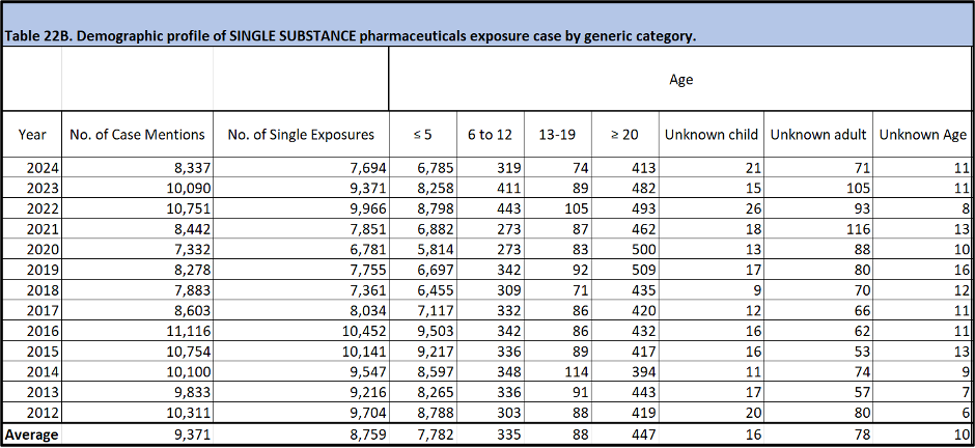
Below are a few observations on statistics for homeopathic agents (alone) on Table 22B:
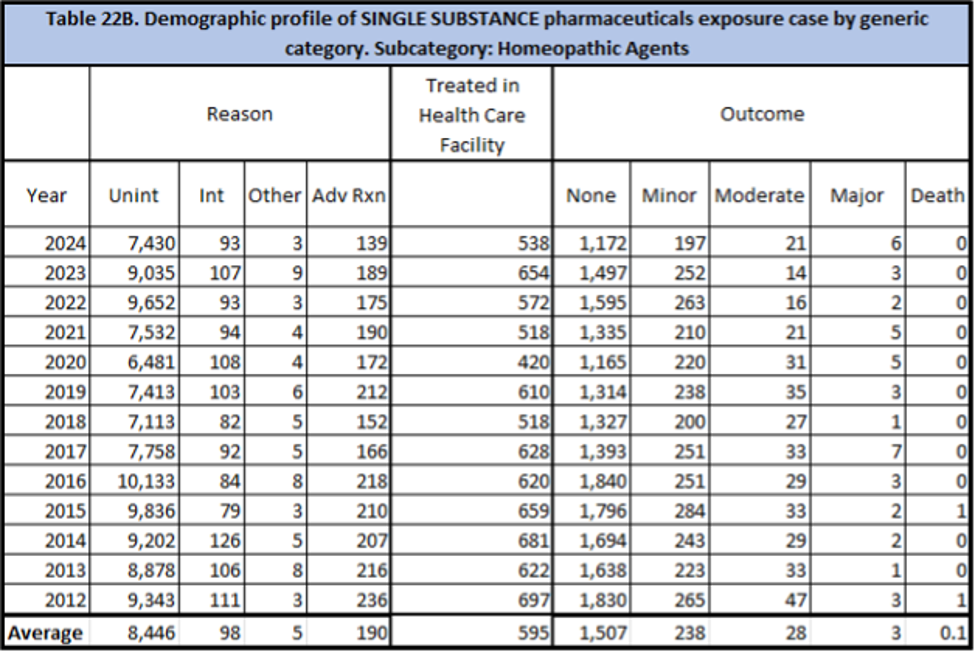
Overall, the number and proportion of major outcome and death are consistently very small in each year, reflecting relatively high level of safety (or low level of major harm) of homeopathic agents.
- The 13-year average of case mentions for homeopathic agents is 9,371. (A total of 2,092,689 human exposures were logged by NPDS in 2024.)
- Interestingly, the annual number of case mentions rises, then falls, then rises again, and falls again; Thus the number of cases doesn’t align with the industry’s steady growth and exposure to more consumers.
- The number of case mentions range from a low of 7,332 to a high of 11,116. While that’s a 51% change, it’s relatively small in comparison to ibuprofen (73k); acetaminophen by itself for adults (45k); hypochlorite bleach (35k), and food products (24k) to name just a few.
- Most other categories are subdivided to the point that the case numbers are very small. For example, there are 14 subcategories for botanical products (blue cohosh, echinacea, ginkgo biloba, ginseng, kava kava, etc.). There are eight subcategories for botanical energy products. “Homeopathic agents” is not subcategorized by product strain or dilution, and therefore the total number of cases can seem higher than many of the products that are subcategorized.
Number of Case Mentions vs. Number of Single Exposures: This shows homeopathic cases (with concomitant substances) verses cases with homeopathic products as the sole suspect drugs. For example, in 2024, there were a total of 8,337 cases that mentioned homeopathic agents. Among these, 7,694 cases (92.3%) had a homeopathic agent as the only exposure.
Ages: An unfortunate statistic is that the age group of 5 years and younger is the largest population for case mentions. The 13-year average of case mentions is 7,782 per year. This is probably relative to the feedback our industry receives that new users of homeopathy tend to be newer parents searching for gentler health solutions for young children. Our industry would provide a service to inexperienced users of homeopathy to better explain what to expect, such as symptoms not being masked, as well as review product packaging for risks to young children.
Reason: NPDS classifies all encounters as either an “exposure case” (concern about an exposure to a substance) or an “information request” (where no one has been exposed). Specialists in Poison Information (SPI) coded the reasons for exposure reported by callers to Poison Centers as follows:
- Unintentional (8,446 annual average for homeopathy) most likely means unintentional exposures in children ages 5 years and younger for homeopathic agents (as opposed to environmental or workplace exposure applicable to other substances). It could also mean improper or incorrect use, or the exact reason is unknown.
- Intentional (98 annual average for homeopathy) could mean suspected suicide, misuse, abuse, or another unknown motive for the exposure.
- Other (5 annual average for homeopathy) could mean the patient is an unintentional victim of a substance that has been tampered or contaminated, or victim or another person’s intent to harm.
- Adverse reaction to a drug (190 annual average for homeopathy) means unwanted effects due to an allergic, hypersensitivity, or idiosyncratic response to the active ingredient(s), inactive ingredient(s) or excipient of a drug, chemical, or other drug substance when the exposure involves the normal, prescribed, labeled or recommended use of the substance.
Negative Health Outcomes: Contributing to homeopathy’s reputation for safety is that only an average of 3 people per year during this 13-year period reported major negative health outcomes. An average of 28 people per year reported moderate negative health outcomes; an average of 238 per year reported minor negative health outcomes; and an average of 1,507 per year reported no negative health outcome.
Deaths: During the 13 years of reports, two deaths were reported that seem miscategorized or tallied incorrectly. This tally is found on Table 22 (as seen above) but details of individual cases are listed in Table 21. “Listing of fatal nonpharmaceutical and pharmaceutical exposures”, which shows the following:
- 2012: There are two cases listed on the 2012 “Table 21. Listing of fatal nonpharmaceutical and pharmaceutical exposures” under “Dietary Supplements/Herbals/Homeopathic”. Case [1812pa] involved Yohimbe. Case 1813h involved “supplement, botanical” and cocaine. One of these substances may have been miscategorized as being a homeopathic agent.
- 2015: There are no cases listed on the 2015 “Table 21. Listing of fatal nonpharmaceutical and pharmaceutical exposures” under “Dietary Supplements/Herbals/Homeopathic”. Thus, it is unknown why or how one death is attributed to a homeopathic agent on Table 22.
Table 21 “Listing of fatal nonpharmaceutical and pharmaceutical exposures” is consistently the largest section of the annual reports where details of individual fatal incidents are listed. The 2024 NPDS documented 2,809 human exposures resulting in death, with 80% judged as being related to the substance reported. The absence of any homeopathic agent by itself throughout this table is also consistent throughout the annual reports. However, the many listing under the combined category of “dietary supplement, herbal, and homeopathic” caused homeopathy to be mentioned in the four tables ranking substances of concern (bullet pointed previously in this article).
Conclusion
While statistics show low incidents for serious outcomes from homeopathic agents, drug manufacturers and the homeopathic community are cautioned against making absolute or extreme claims regarding safety, especially for specific products. However, we can proudly say that homeopathy continues building upon its remarkable and long safety record and is the safest class of drug overall. Nevertheless, manufacturers might consider reviewing their product packaging for risks to you children.
Also to keep in mind, statistics from the America’s Poison Centers’ National Poison Data System are only one way to measure the safety of homeopathic product use in the United States. Consumers and health care professional report adverse events to several systems, include the U.S. Food and Drug Administration’s Adverse Event Reporting System (FAERS) database.
References
All NPDS annual reports used for this compilation are available at: https://poisoncenters.org/annual-reports
1. Michael C. Beuhler, Ryan Feldman, David D. Gummin, James B. Mowry, Laura J. Rivers, Kaitlyn Brown, Nathaniel P. T. Pham, Krys Johnson-O’Leary, Daniel A. Spyker & Alvin C. Bronstein (2025) 2024 Annual Report of the National Poison Data System® (NPDS) from America’s Poison Centers®: 42nd Annual Report, Clinical Toxicology, 63:12, 1029-1280, DOI: 10.1080/15563650.2025.2571299
2. David D. Gummin, James B. Mowry, Michael C. Beuhler, Daniel A. Spyker, Laura J. Rivers, Ryan Feldman, Kaitlyn Brown, Nathaniel P.T. Pham, Alvin C. Bronstein & Carol DesLauriers (17 Dec 2024): 2023 Annual Report of the National Poison Data System® (NPDS) from America’s Poison Centers®: 41st Annual Report, Clinical Toxicology, DOI: 10.1080/15563650.2024.2412423
3. David D. Gummin, James B. Mowry, Michael C. Beuhler, Daniel A. Spyker, Laura J. Rivers, Ryan Feldman, Kaitlyn Brown, Nathaniel P.T. Pham, Alvin C. Bronstein & Carol DesLauriers (2023) 2022 Annual Report of the National Poison Data System® (NPDS) from America’s Poison Centers®: 40th Annual Report, Clinical Toxicology, 61:10, 717-939, DOI: 10.1080/15563650.2023.2268981
4. David D. Gummin, James B. Mowry, Michael C. Beuhler, Daniel A. Spyker, Laura J. Rivers, Ryan Feldman, Kaitlyn Brown, P. T. Pham Nathaniel, Alvin C. Bronstein & Julie A. Weber (2022) 2021 Annual Report of the National Poison Data System© (NPDS) from America’s Poison Centers: 39th Annual Report, Clinical Toxicology, 60:12, 1381-1643, DOI: 10.1080/15563650.2022.2132768
5. Gummin DD, Mowry JB, Beuhler MC, Spyker DA, Bronstein AC, Rivers LJ, Pham NPT, Weber J. 2020 Annual Report of the America’s Poison Centers’ National Poison Data System (NPDS): 38th Annual Report. Clin Toxicol (Phila). 2021 Dec;59(12):1282-1501. doi: 10.1080/15563650.2021.1989785. PMID: 34890263.
6. Gummin DD, Mowry JB, Beuhler MC, Spyker DA, Brooks DE, Dibert KW, Rivers LJ, Pham NPT, Ryan ML. 2019 Annual Report of the America’s Poison Centers’ National Poison Data System (NPDS): 37th Annual Report. Clin Toxicol (Phila). 2020 Dec;58(12):1360-1541. PubMed PMID: 33305966.
7. Gummin DD, Mowry JB, Spyker DA, Brooks DE, Beuhler MC, et al. 2018 Annual Report of the America’s Poison Centers’ National Poison Data System (NPDS): 36th Annual Report. Clin Toxicol (Phila). 2019 Dec;57(12):1220-1413. PubMed PMID: 31752545.
8. Gummin DD, Mowry JB, Spyker DA, Brooks DE, Osterthaler KM, et al. 2017 Annual Report of the America’s Poison Centers’ National Poison Data System (NPDS): 35th Annual Report. Clin Toxicol (Phila). 2018 Dec 21;:1-203. PubMed PMID: 30576252.
9. Gummin DD, Mowry JB, Spyker DA, Brooks DE, Fraser MO, Banner, W, et al. 2016 Annual Report of the America’s Poison Centers’ National Poison Data System (NPDS): 34th Annual Report. Clin Toxicol (Phila). 2017 Dec;55(10):1072-1252. PubMed PMID: 29185815.
10. Mowry JB, Spyker DA, Brooks DE, Zimmerman A, Schauben JL. 2015 Annual Report of the America’s Poison Centers’ National Poison Data System (NPDS): 33rd Annual Report. Clin Toxicol (Phila). 2016 Dec;54(10):924-1109. PubMed PMID: 28004588.
11. Mowry JB, Spyker DA, Brooks DE, McMillan N, Schauben JL. 2014 Annual Report of the America’s Poison Centers’ National Poison Data System (NPDS): 32nd Annual Report. Clin Toxicol (Phila). 2015;53(10):962-1147. PubMed PMID: 26624241.
12. Mowry JB, Spyker DA, Cantilena LR Jr, McMillan N, Ford M. 2013 Annual Report of the America’s Poison Centers’ National Poison Data System (NPDS): 31st Annual Report. Clin Toxicol (Phila). 2014 Dec;52(10):1032-283. PubMed PMID: 25559822.
13. Mowry JB, Spyker DA, Cantilena LR Jr, Bailey JE, Ford M. 2012 Annual Report of the America’s Poison Centers’ National Poison Data System (NPDS): 30th Annual Report. Clin Toxicol (Phila). 2013 Dec;51(10):949-1229. PubMed PMID: 24359283.